// Part 1 · Stress & anxiety
What is
stress?
Your body's own incident response
A physical and emotional response to pressures or demands, which happens when the challenges you face exceed your perceived ability to cope.
- Not a medical condition in itself, but persistent stress can feed into physical and mental health problems.
- No definitive test. It's recognised through common signs and patterns (below).
The Yerkes–Dodson law
Performance improves as pressure rises, but only up to a point. Past that, more stress makes us worse, not better.
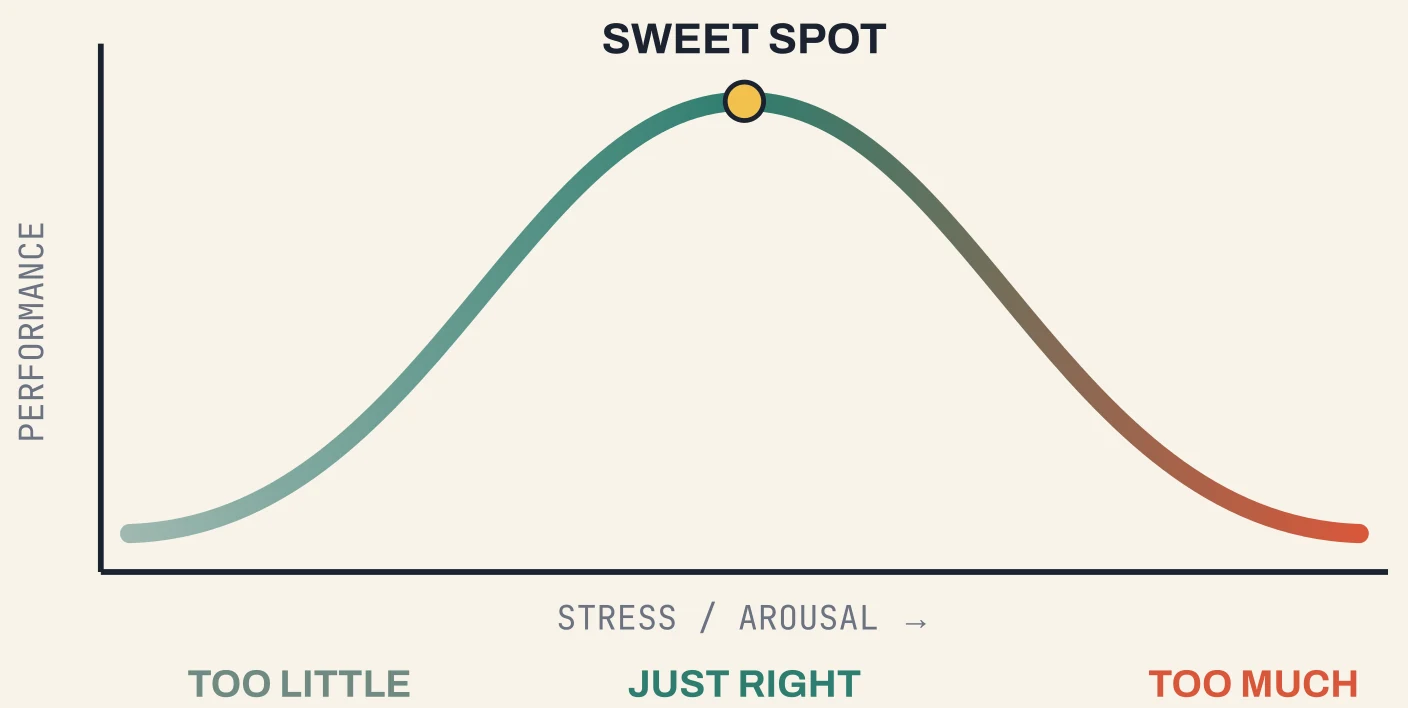
Boredom, low motivation, underperformance
Focus, energy, your best work
Overwhelm, anxiety, mistakes
"Arousal" here means how switched-on your brain and body are, nothing more. It's a simplified, widely used model, not a precise law.
// Detection engineering
Signs of
stress
Indicators of compromise for humans
Under pressure, your body releases stress hormones like adrenaline and cortisol to get you ready to fight or run. Brilliant for a two-hour incident. Not so good for a four-month project. Tick what you've noticed lately.
In your body
- Muscle aches and headaches
- Sleep problems
- Fatigue
- Feeling sick, dizzy or faint
- Existing health problems getting worse
- Changes to your menstrual cycle
In how you behave
- Eating too much or too little
- Irritability or mood swings
- Crying or feeling tearful
- Unable to concentrate
- Grinding teeth, clenching your jaw
- Withdrawing from people
Bored-out is real too
Look at the left side of the curve. Weeks with nothing to do, such as waiting on clearances, sitting "on the bench" between projects, or a role that's gone quiet, can be just as draining as overwork. Low motivation, skipping exercise, drinking more and worrying that you're not needed are all common there.for i in 1..4: inhale 4s → hold 4s → exhale 4s → hold 4s
# slows your heart rate · works mid-call · nobody will notice
// Part 1 · Stress & anxiety
What is
anxiety?
When the alarm keeps ringing after the threat has gone
A psychological and physical response involving persistent worry, fear or unease, often out of proportion to the situation or without a clear trigger.
Anxiety isn't always a medical condition. But ongoing or intense anxiety can be part of an anxiety disorder, such as generalised anxiety disorder (GAD), which deserves a professional assessment.
In your body
- A churning stomach
- Sleep problems
- Faster breathing
- Fast, thumping or irregular heartbeat
- Panic attacks
- Restless, can't sit still
In your mind
- Tense, nervous, can't relax
- Low mood
- Constant need for reassurance
- Worrying people are upset with you
- Rumination
- Worrying about what might happen
Grounding: the 5-4-3-2-1 scan
When anxiety spirals, slowly name what's around you: 5 things you can see (a mug, a window, your keyboard), 4 things you can touch (your feet on the floor, the chair at your back), 3 things you can hear (a laptop fan, traffic, your breathing), 2 things you can smell (coffee, soap) and 1 thing you can taste (a sip of water). It pulls your attention back into the present.Rumination: replaying a bad experience or situation over and over, like a failed exploit stuck in a loop.
// Threat intelligence
Why cyber
is exposed
Stress and anxiety threat actors in our industry
Chronic workload stress CRITICAL
Continuous monitoring and alert queues that never end. "Always on alert" slowly becomes vigilance fatigue, exhaustion and burnout.
Back-to-back engagements CRITICAL
A new client, scope and tech stack every week or two, with utilisation targets and report deadlines stacking up behind each test. There's rarely time to recover in between.
Acute incident stress HIGH
Responding to breaches creates high-pressure moments: adrenaline spikes, broken sleep and mental fatigue, often outside working hours.
The "empty report" fear HIGH
Days into a test with nothing to show. Clients expect findings, and a clean report can feel like proof you missed something, even when the environment is genuinely solid.
Fear of failure anxiety HIGH
A single mistake could mean a breach, financial loss or reputational damage. And blame often lands on people, not systemic failures.
Organisational pressure MEDIUM
Conflicting priorities: strong security without disrupting the business, on a tight budget, explained to non-technical stakeholders.
// Coping strategy 01
Organise
your time
Scheduling is a security control
- 1
Find your best time of day
Do high-focus work when you're most alert: mornings if you're a morning person, evenings if you're not.
- 2
List and rank your tasks
Most important first. Timetable when you'll tackle each one. Ask a manager or colleague to help prioritise, and postpone what isn't urgent.
- 3
Don't take on too much at once
Fewer tasks, each done well, beats ten tasks done badly in parallel.
- 4
Take regular breaks, keep a steady pace
Hard to do when stressed. That's exactly when it helps most.
- 5
Ask someone to help!
Delegating frees time for the tasks that are actually causing the stress. Asking isn't weakness, it's load balancing.
Why it works
- gives a sense of control
- prevents last-minute pressure
- keeps focus on what matters
- protects work–life balance
- reduces mental overload
Today's top three
✎ Fill this in on the printable guide
// Coping strategy 02
Identify your
triggers
Awareness is the first step to control
Knowing what sets you off lets you anticipate problems and prepare, even when you can't avoid the situation.
- Track your patterns. Keep a short log of stressful moments to spot recurring triggers.
- Controllable vs. uncontrollable. Spend energy where you have influence, not on what's outside your control.
- Check the environment. Noise, interruptions and bad ergonomics count. Triggers aren't always tasks.
- Recognise emotional triggers. Fear of failure, perfectionism, feeling unprepared.
- Use triggers as signals. Once you know them, they become early alerts to start coping before it's overwhelming.
Trigger log
| When | What happened | In my control? | What helped |
|---|---|---|---|
✎ Fill this in on the printable guide
// Coping strategy 03 · Baseline hardening
Don't forget
the basics
Boring controls that block most attacks
01 · Eat right
Proper nutrition fuels your body and stabilises your mood. Regular meals, away from the keyboard.
02 · Exercise
Physical activity reduces stress and clears your head. Even a 10-minute walk counts.
03 · Sleep right
Quality sleep restores your mind and builds resilience. Most adults need 7–9 hours. Screens off before bed helps.
04 · Speak to someone
Sharing how you feel eases the load. Friends, family, a colleague you trust.
05 · Seek professional advice
A GP or therapist can give you proper tools. You don't need to wait until it's a crisis.
Alcohol & nicotine: a false patch
They feel like relief in the moment, but they create a cycle of dependency. Nicotine withdrawal raises anxiety, and alcohol disrupts sleep and lowers mood. Over time both make stress, anxiety and depression worse.This week's baseline audit
✎ Fill this in on the printable guide
Print it for your team
This page is pages 3 to 9 of the free Self Pwning field guide. The PDF has the worksheets ready to fill in, and prints as an A4 booklet.
Need to talk now?
If you're in immediate danger, call your local emergency number: 999 (UK) · 911 (US/Canada) · 112 (EU) · 000 (Australia). For free, confidential support, see the helplines on the home page.
Not medical advice. This guide is written by a security person, not a mental health professional. If you're struggling, talk to a GP, doctor or therapist.