// Part 3 · Imposter syndrome
Imposter
syndrome
Social engineering, run by your own brain
A psychological pattern where you downplay your achievements and believe you're secretly a fraud who doesn't deserve them.
It's not a medical condition and there's no test for it. It's sometimes called the imposter phenomenon for that reason.
Symptoms can include
- Sensitivity to small mistakes or criticism
- Burnout from overworking
- Fear of success or failure
- Impossibly high standards
- Low self-confidence
- Crediting luck or others for your success
Who does it affect?
As with most research here, studies vary and sometimes contradict each other.
// Observed in the wild
Imposter syndrome
in cyber
Offence, defence, GRC, research. Nobody's immune.
- High expectations. Pressure to perform and fear of falling short feed self-doubt.
- Constantly evolving tech. New tools, TTPs, cloud, AI. Falling behind feels inevitable.
- Fear of failure. When the stakes are high, any mistake feels like proof.
- Isolation. Remote work means less casual praise, and more room to imagine people talking behind your back.
Spot the imposter thoughts
| Pattern | What it sounds like |
|---|---|
| Self-doubt | "I only got this job through luck. I'll be found out." |
| Fear of failure | "I'm not going to find anything on this test." |
| Procrastination | "If I don't start, I can't prove I'm bad at it." |
| Overworking | "Extra hours will make up for my lack of skill." |
| Comparison | "The last testers found a critical. They must be better." |
| Overreacting to feedback | "Report QA comments mean they've figured me out." |
| Downplaying wins | "Anyone would have found that bug." |
The colleague test
Would you say that thought to a teammate who'd just done the same work? If not, it's not a fair assessment. It's the imposter talking.// Coping strategies
Talk to others.
Stop the scroll.
Two patches for the imposter voice
Talk to others
Find a mentor
Someone more experienced who understands the challenges. They don't need to have answers. Listening is enough.
Get a cheerleader (or several)
A source of positivity to remind you what you're capable of and what you've already overcome. Family and friends count, not just colleagues.
Just talk
If a mentor feels like one more person to perform for, skip it. A quick chat to get the thoughts out of your head is often enough. Hearing it out loud shows you how inaccurate it sounds.
Stop the scroll
- The comparison loop. The infinite feed shows you everyone's CVEs, bug bounty payouts and shiny tools, but never the hours, the luck or the years behind them.
- Confirmation bias. We seek out and remember whatever "proves" we're an imposter.
- Small doses. Cap your time. One well-known study found limiting social media to about 30 minutes a day reduced loneliness and low mood.
Source: Hunt et al., University of Pennsylvania, Journal of Social and Clinical Psychology (2018).
Feed hygiene
Mute accounts that leave you feeling worse. Set app timers. Follow people who share their failures and learning, not just their wins.// Worksheet · Call it out
The BS
list
Debunk the obstacles your brain invents
- 1
Goal
Write down what you want to achieve.
- 2
Obstacles
List what you feel is stopping you.
- 3
Call BS
Under each obstacle, write why it's not the barrier you think it is.
Worked example · Goal: move from the SOC into pentesting
| Obstacle | Calling BS |
|---|---|
| "I don't have an offensive cert" | Years of triaging real attacks means I know what they look like |
| "I can't really code" | I've written plenty of scripts to automate my day job |
| "I've never worked with clients" | I explain incidents to non-technical stakeholders every week |
Your turn · Goal:
| Obstacle | Calling BS |
|---|---|
✎ Fill this in on the printable guide
// Worksheet · Evidence collection
The cookie
jar
A method from David Goggins' book Can't Hurt Me
- 1
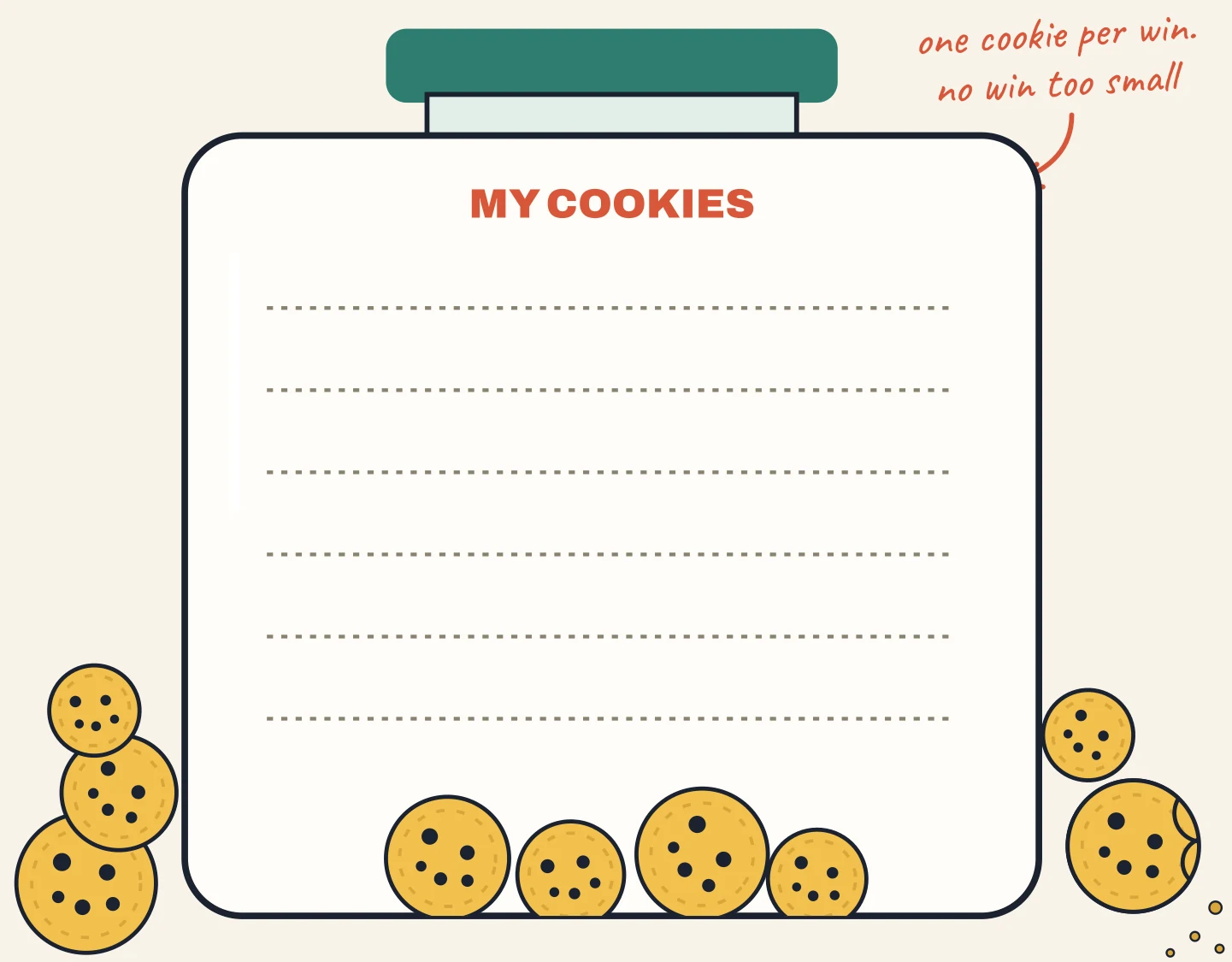
Collect your cookies
Notice personal wins, however small: a tough task finished, a fear faced, a kind thing you did.
- 2
Fill your jar
Write them down. Each cookie is evidence of your resilience and ability.
- 3
Reach into the jar
When doubt hits, read them back. Past wins are proof you can handle the next challenge.
✎ Fill this in on the printable guide
Print it for your team
This page is pages 14 to 18 of the free Self Pwning field guide. The PDF has the worksheets ready to fill in, and prints as an A4 booklet.
Need to talk now?
If you're in immediate danger, call your local emergency number: 999 (UK) · 911 (US/Canada) · 112 (EU) · 000 (Australia). For free, confidential support, see the helplines on the home page.
Not medical advice. This guide is written by a security person, not a mental health professional. If you're struggling, talk to a GP, doctor or therapist.